Tuesday, August 21, 2012

Thursday, May 17, 2012
Burg Eltz Caslte


Beethoven's Birth House


Beethoven was born December 16, 1770 in Bonn, Germany. He grew up in Bonn, Germany in a very unhappy home. His abusive alcoholic father would force him to practice the piano at a very young age and would punish him when he made mistakes. By the age of twelve, Beethoven was earning money for his family by playing organ and composing.
When he was older, Beethoven moved to Vienna and was taught by Franz Joseph Haydn. Beethoven died March 26, 1827 in Vienna, Austria
Beethoven's birth house still stands today as a museum, and houses the largest Beethoven collection in the world.

Friday, February 10, 2012
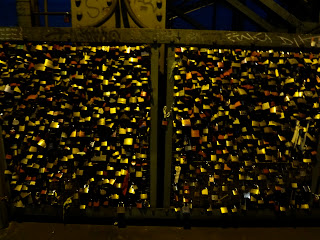
Cologne's Hohenzollern Bridge
The Hohenzollern Bridge, is a bridge crossing over the Rhine river in the city of Cologne, and is the most heavily used railway bridge in Germany. The Cologne Bridge is famous for having "love padlocks" that cover most of the bridge's railway fences. Love locks symbolize everlasting love; the idea is you buy a lock, affix the lock to the railway fence, then write you and your sweethearts names/initials on it, and afterwords through the key into the river. These Love Padlocks Bridges did not start in Germany; the origin is unknown along with the date. Bridges similar to the Love Padlocks Bridge in Cologne can be found all over the world and the tradition still continues today.



Monday, January 30, 2012
Haribo
Haribo is an acronym for Hans Riegel (founder's name) and Bonn(city in Germany where it was founded). It was founded in 1920. Haribo is known for making the first gummy candy in 1922, and also the first gummy bear. Haribo started out in a small backyard laundry-kitchen, but now is the worlds largest manufacturing business for gummy and jelly candies; with five factories in Germany and thirteen others throughout Europe. All kids in Germany grow up eating Haribo and is as well-know/popular to kids in Germany as Hershey is to kids in the USA.


Tuesday, January 10, 2012
New Year's
Germans Celebrate the New Year too, and same as Americans they either have a party, go to a party, or celebrate with close friends and family. Even though Germans don't watch the big ball drop in Times Square or watch other big TV countdowns, they still have other ways of having fun. A special New Year's dinner is cooked and a long dinner is eaten with lots of conversation, at midnight the exciting part happens, fireworks are lit off by every house. There are more fireworks lit off in Germany on New Years then in the USA on the Fourth of July. Fireworks are being lighten off for about 30 or more minutes; it is one of the most amazing experiences one can ever have staring up at the sky.


Marzipan pigs are given to people for luck, especially on New Year's!
Sunday, January 8, 2012
Santa who???
Germany does not have a Santa Claus that delivers the presents, instead they have the Christkind (Christ child) which is the traditional German gift bringer. Some Germans interpret the Christkind as a angel while other think of the Christkind as baby Jesus. Children never get to see the Christkind unlike children in America who get to see Santa at the mall. On Christmas Eve the Christkind come during the day, and the room containing the tree is locked. Usually when the children return from church or later in the night, a bell is rung, signifying the Christkind has come, and the door is "magically" unlocked. Under the tree sits all the presents and just like in America everyone opens them.

 Pictured above is a traditional German present that was brought to me by the Christkind, this wooden figure is hand carved and painted. It opens and you put incense in the bottom portion, light it, put the top back on, and then the smoke comes through the mouth. The Christkind ( my host parents) was very nice to bring me a Santa Claus one which was probably hard to find.
I have seen Santa figures and decorations in Germany though, not a lot but some; not to mention the American Christmas music playing sometimes mentions Santa Claus or reindeer. Almost all Germans do know about our Santa Claus and how we have to wait til Christmas day to open our presents.


I have seen Santa figures and decorations in Germany though, not a lot but some; not to mention the American Christmas music playing sometimes mentions Santa Claus or reindeer. Almost all Germans do know about our Santa Claus and how we have to wait til Christmas day to open our presents.
Christmas Eve and Christmas Day
Germans like Americans also celebrate Christmas Eve and Day, only just a little bit differently. In America for Christmas Eve most of the day is spent cooking a big meal and preparing for guests. While in Germany a big meal is not common on Christmas Eve, a simple meal is eaten instead, such as fondue or schnitzel. The Christkind(Christ-angel), Germans version of our Santa, comes on Chistmas Eve to deliver the presents, and they are opened on Christmas Eve instead of Christmas Day like in America. American Christmas music is played and there is talk around the dinner table, but mostly everyone is excited to open up their presents and happy to be with their family.
On Christmas Day like in America you just spend time with family, maybe watch movies or play games. Some people go on Vacation for Christmas and sometime relatives come to visit.
 Presents I got from the Christkind!
 Of course lots of chocolate was given!
On Christmas Day like in America you just spend time with family, maybe watch movies or play games. Some people go on Vacation for Christmas and sometime relatives come to visit.


Saturday, December 31, 2011
Christmas Tree
Christmas trees in Germany are real, you will not normally find plastic Christmas trees like in the U.S. Families go out and pick their own tree at a tree farm, and they are not as expensive as the real trees in the U.S. My host family got their tree for around 20 euros while in America real trees cost around 100 dollars. Christmas trees are not usually decorated until the week before Christmas, using real glass ornaments and not as much lights as American trees have. Usually traditional colors are used, such as red and green, but sometimes blue, silver, and gold are added too.


Christmas Markets
During the winter people from all over Europe come to Germany and shop at their famous Christmas Markets. These markets are located all over Germany, but each have a different style and size. These historic Christmas Markets offer homemade Christmas gifts, crafts, not to mention roasted chestnuts and other delicious foods. These markets usually start the last week in November and end Christmas Eve, and open from 10 am to 8 or 9 pm each day.


Christmas Market Bonn, Germany
Wednesday, December 28, 2011
Advent Calendars
Like in America kids in Germany do get Advent calendars with the most popular ones containing chocolate. Other popular ones have toys, candy, little notes or parts of a story, and I have seen one that was an Advent calendar with different types of tea each day.
 This is a picture of the Advent calendar that I got, which contained chocolate!
Another German custom is Advent wreaths, which are normally hand made by a family member. Advent wreaths are made of evergreen leaves and have four candles, signifying the 4 sundays before Christmas. Even thought the one my host family and I made is not a wreath, it still held the same purpose .


Another German custom is Advent wreaths, which are normally hand made by a family member. Advent wreaths are made of evergreen leaves and have four candles, signifying the 4 sundays before Christmas. Even thought the one my host family and I made is not a wreath, it still held the same purpose .

Saturday, December 10, 2011
9th of December St Nicholas Day
On the ninth of December children wake up in Germany, and to their surprise they find candy, chocolate, and fruit in their shoes. The night before children are told by their parents to clean their shoes and place them by the door so St. Nicholas has some place to leave the treats. Some people celebrate St. Nicholas in America but most children receive their gifts in stocking instead of shoes.
Sunday, November 20, 2011
Food
In Germany, most people eat three meals a day and it is not common to have snacks in between. The meals are big and usually last long, in Germany eating together is a family activity and a social event. Only expect one hot meal a day, the rest are usually cold and consist of sandwiches or some sort of meat. Bread is eaten at almost every meal, and bought fresh from the bakery everyday, and you cannot forget Germany's famous pretzels. Ice cream in Germany comes from Italy and it is very good, the second to last photo is of Spaghetti ice cream, which is ice cream put though a pasta machine and then topped with raspberry sauce.


St. Martin's Day
St. Martin's Day is a holiday, celebrated in Southern Germany on November 11 and it is like our Halloween, but more religious.
The holiday is based off of a religious legend, and one version goes like this; Martin, a Roman Solider, was traveling by horse through a snowstorm. He saw a beggar while traveling dying from the cold, so he decided to save him, he took his sword and cut his cloak in half, and gave half to the beggar. He dreamed latter that night about Jesus, he was wearing half of his cloak; Jesus turned out to be the beggar.
To celebrate this holiday the German children make lanterns out of paper either in their school or at home. On the night of St. Martin's children reenact the legend and then put candles in their paper lanterns to light their way, as they walk to different houses and sing. They ring the door bells and sing songs about St. Martin to the people that answer, in return the children get given candy (just like Halloween)!
Here is one of the songs the children sing.
Ich geh mit meiner Laterne und I go with my lantern and
Meine Laterne mit mir. Dort oben Leuchten die My lantern with me. There above light
Sterne, hier unten, da leuchten the stars, here below, there
wir. Mein Licht geht aus, wir gehn nach haus. we light. My light goes out, we go back home La-bim-mel, la-bam-mel, la-bum La-bim-mel, la-bam-mel, la-bum
The holiday is based off of a religious legend, and one version goes like this; Martin, a Roman Solider, was traveling by horse through a snowstorm. He saw a beggar while traveling dying from the cold, so he decided to save him, he took his sword and cut his cloak in half, and gave half to the beggar. He dreamed latter that night about Jesus, he was wearing half of his cloak; Jesus turned out to be the beggar.
To celebrate this holiday the German children make lanterns out of paper either in their school or at home. On the night of St. Martin's children reenact the legend and then put candles in their paper lanterns to light their way, as they walk to different houses and sing. They ring the door bells and sing songs about St. Martin to the people that answer, in return the children get given candy (just like Halloween)!
Here is one of the songs the children sing.
Ich geh mit meiner Laterne und I go with my lantern and
Meine Laterne mit mir. Dort oben Leuchten die My lantern with me. There above light
Sterne, hier unten, da leuchten the stars, here below, there
wir. Mein Licht geht aus, wir gehn nach haus. we light. My light goes out, we go back home La-bim-mel, la-bam-mel, la-bum La-bim-mel, la-bam-mel, la-bum
Sunday, October 30, 2011
Halloween
Halloween is not celebrated in Germany like in America, trick or treating is not done and most kids do not dress up in costumes. Germans do know of the holiday in America and it is become more polular here, but more among the teenagers who want to have halloween parties. Some kids do dress up and go to some houses to get candy, not very common though, but they do not say "tick or treat." Some places and houses are decortated for Halloween but not as extravagent as in the U.S.A and nobody puts up Halloween lights. Carving pumkins has become very popular in the last few years along with watching horror movies around the Halloween time.
Monday, October 24, 2011
On Monday October 31 there is a Holiday
Only in Southern Germany, because their are more christian people, is this holiday celebrated. This holiday is to honor and remember the dead, families go to the graves of their loved ones to lay flowers and get the grave ready for winter. Families also light candles and place them in the latern holders on the grave, this is an important part of the holiday.
Sunday, October 16, 2011
Lunch during school days
Like in America it is normal for a person to eat three meals a day in Germany. One of them being a hot/cooked meal, usually eaten at lunch time. Lunch is typically not served at school, so a German students either go home for lunch, to the city, or brings their own lunch from home. Lunch breaks for school are typically an hour and forty-five minutes, giving the student enough time to go home if they want. During the 15 minute breaks between every 2 classes, student normally go out to the courtyard and eat a snack, such as fruits, vegetables, sweets, or sandwiches. It is also normal for student to eat during class here, which is typically not allowed in America.
Subscribe to:
Posts (Atom)